Preliminary results from 7 November give the centre-right coalition of National, ACT and NZ First 67 seats, and the centre-left bloc of Labour, the Greens and Te Pāti Māori 57. The Opportunity Party enters Parliament with at least seven seats, and a majority requires 66 in an enlarged house.
As we wait for the final result, due on 27 November, let’s look at what both collations stand for and how they could affect the construction industry.
BondedNZ does not endorse any political party. This newsletter is general commentary on published policy only.
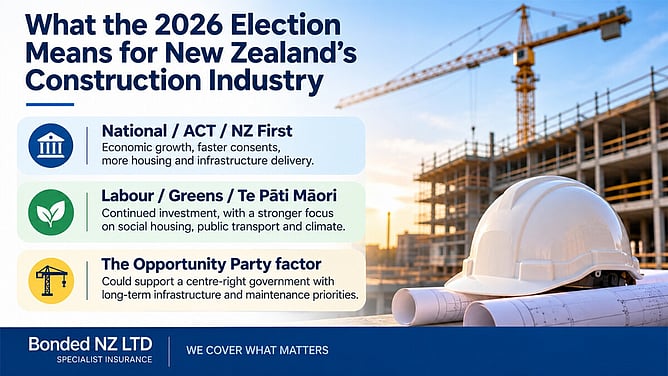
Option 1: National / ACT / NZ First
A continuation of the current coalition would prioritise economic growth, infrastructure delivery, housing supply and regulatory reform, with emphasis on getting projects consented and delivered faster.
On planning reform, we’ve already seen significant work done. The bills replacing the Resource Management Act passed their third reading on 22 September 2026, and there’s been substantial activity in roading, water network renewals, flood resilience works, public transport upgrades and housing-enabling.
National and ACT favour leaner government operations, stronger procurement discipline and more accountability for delivery. That could mean faster approvals and clearer decision-making.
Option 2: Labour / Greens / Te Pāti Māori
A Labour-led coalition would generally maintain infrastructure spending with a different approach, favouring social housing, public transport, climate adaptation, renewable energy and community infrastructure.
Labour has committed to no fuel excise increase in its first term and would scale National Land Transport Fund spending to available funds. It would also extend the Apprenticeship Boost to civil trades from July 2027, which matters for any firm carrying apprentices.
Meanwhile, the Greens have promised $7.42 billion for rail and $13.65 billion for light rail or bus rapid transit across three cities, funded partly by moving NLTF money away from roads.
This means contractors could face additional procurement requirements covering sustainability, emissions reporting, workforce development, Māori outcomes and social procurement. Compliance and reporting costs would likely rise, and project development may become more consultation driven.
On employment costs, ACT is campaigning to freeze the adult minimum wage for three years and introduce a lower training wage for workers under 20.
Option 3: the Opportunity Party factor
Westpac's assessment is that a centre-right government now looks more likely, probably with the Opportunity Party supporting it on confidence and supply in exchange for policy concessions, without joining Cabinet.
Opportunity has the most systemic infrastructure policy of any party. It would legislate the 30-year National Infrastructure Plan, create a National Infrastructure Agency, direct 60 per cent of future spending to maintenance, and borrow up to $60 billion over ten years.
Construction outlook
The underlying pipeline is relatively stable regardless of who governs. MBIE forecasts infrastructure activity to reach $19.6 billion by 2030. More than $200 billion of projects are underway or planned within the National Infrastructure Pipeline managed by the Infrastructure Commission.
Meanwhile, residential construction has already turned, with 41,268 new homes consented in the year ended August 2026, up 21.1%.
Labour has said it would not cancel projects signed before the election. Early-stage roading projects without contracts in place will face the greatest risk under a change of government.
Key takeaway
Total infrastructure demand looks reasonably secure under either party, and the industry's own assessment is that the parties agree more than they differ. However, businesses should consider the execution speed, procurement requirements and administrative burden.
Having the right insurance and bond in place protects builders and gives them peace of mind in uncertain times. If you’d like added protection for your projects, Bonded NZ offers a range of competitive insurance, warranties, and surety bonds. Contact our team today to find out more.
Market Your Business With BondedNZ!
To support local businesses, Bonded NZ would like to promote our clients' businesses, without obligations. If you have a special deal, promotion, new service, or offering, we can spread the word on our social media channels and our newsletters.
Please reach out to your BondedNZ contact person for details, or learn more about it here.