New Zealand voted on 7 November, and as we wait for the official results due on 27 November 2026, there’s plenty for SMEs to consider.
Preliminary results give the incumbent National, ACT and New Zealand First coalition 67 of 131 seats, a majority of two. However, a National-led government dependent on Opportunity votes would be a different policy environment again.
BondedNZ does not endorse any political party. This newsletter is general commentary on published policy only.
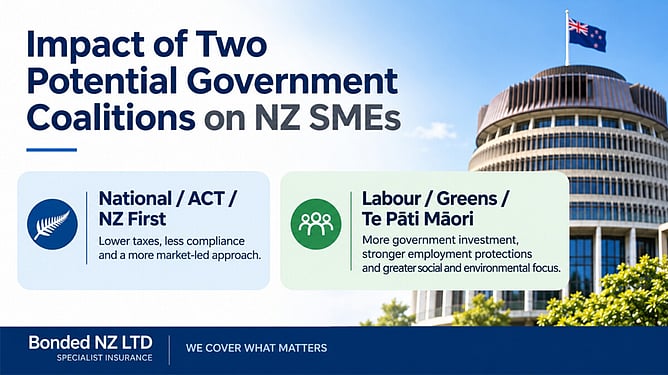
1. National / ACT / NZ First
This coalition favours a more market-led approach. Its priorities are lower taxation, private-sector investment, reduced compliance costs and encouraging businesses to employ and invest.
The coalition has introduced business-friendly policies in its tenure. For example, Investment Boost, introduced in Budget 2025, lets businesses immediately deduct 20 per cent of the cost of eligible new productive assets.
Then there’s National's 47-point Small Business Plan, announced on 7 October 2026, which is largely a compliance package. It proposes a Tell Government Once service and also includes a fast track for minor employment disputes at the Employment Relations Authority.
On GST, National is offering a review of the compulsory registration threshold rather than an increase. The threshold has sat at $60,000 since 2009.
Government departments
Under the National, we can expect continued pressure to reduce public-sector staffing, consolidate departments and focus on measurable outcomes. For SMEs, this could mean faster decisions, fewer administrative layers and lower compliance costs.
However, the risk is that cost-cutting could thin departmental expertise, slow approvals or weaken support services. For any business reliant on public-sector contracts, this fiscal restraint by the government is also a risk.
2. Labour / Greens / Te Pāti Māori
This coalition places greater emphasis on government investment, employment protections, redistribution and environmental and social objectives, with more active government involvement in the economy.
Labour's Small Business Action Plan, released on 6 August 2026, states the following:
Large businesses required to pay small suppliers within 15 days on invoices of $25,000 or less, and to publish how quickly they pay. Labour has not publicly defined what counts as a large business.
The asset write-off lifted from $1,000 to $10,000 for businesses with annual turnover below $10 million, from July 2027.
The GST registration threshold raised from $60,000 to $80,000 from 1 July 2028, taking around 35,000 of the smallest operators out of the GST system.
A target of 15 per cent of government contracts going to small businesses, with larger contracts broken into smaller jobs local firms can realistically tender for.
Labour's proposed capital gains tax on investment and commercial property, and its employment law changes, could increase costs or dampen investment appetite in some sectors.
For the other parties in the coalition: The Greens would pursue higher taxes on wealth and large corporations alongside stronger environmental, employment and sustainability requirements. Te Pāti Māori would emphasise Māori business development and economic participation.
Government departments
Under this coalition, we can expect greater willingness to expand government programmes, departmental staffing and public investment, with more weight given to consultation, environmental considerations and employment standards when approving projects and awarding contracts.
Where both coalitions agree
National proposes a Tell Government Once service. Labour proposes a tell us once approach, so businesses are not repeatedly supplying the same information to different agencies. Both also propose some form of small-business regulatory impact assessment.
For many SMEs, a government that genuinely simplifies compliance processes and makes timely, consistent decisions is genuinely valuable
Comparison at a glance
| Business consideration | National / ACT / NZ First | Labour / Greens / TPM |
|---|---|---|
| Business taxation | Generally favourable | Potentially less favourable |
| Employment costs | Likely lower pressure | Likely higher pressure |
| Compliance requirements | Likely to reduce | Likely to increase |
| Capital investment incentive | Investment Boost retained | Investment Boost scrapped to fund SME package |
| GST registration threshold | Review only | Lift to $80,000 from July 2028 |
| Government infrastructure spending | More fiscally restrained | Greater emphasis on investment |
| Government procurement | Market-led approach | More targeted SME support |
| Government efficiency | Smaller, leaner departments | More active government involvement |
Key takeaway
Until the special votes are counted on 27 November, and any coalition agreement is signed after that, SMEs should assess their risks and take control of their business. The practical step now is to work out which of those two profiles your business fits, so you can move quickly once the government has been elected.
Bonded NZ offers a range of competitive insurance, warranties and surety bonds, and we tailor it to how your business operates.
Contact our team today to review your cover.
Market Your Business With Bonded NZ
To support local businesses, we'd like to promote our clients' businesses for free. If you have a special deal, promotion, new service, or offering, we can spread the word across our social media channels and newsletters.
Please reach out to your Bonded NZ contact person for details, or learn more about it here.