New Zealand construction is coming out of the 2024-25 downturn. Recovery is there, but it is still uneven.
For anyone running a construction business, here is a snapshot of where things are in October 2026. We’ll look at both residential and commercial construction works.
The numbers
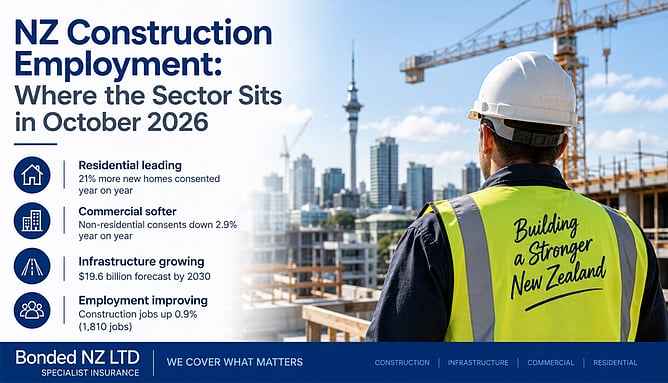
Consents are the biggest signals of construction activity. There were 41,268 new homes consented in the year ended August 2026, up 21 per cent on the year ended August 2025. This number builds on the June milestone, when 40,581 new homes were consented in the year ended June 2026. June was the first time the annual figure had passed 40,000 since 2023.
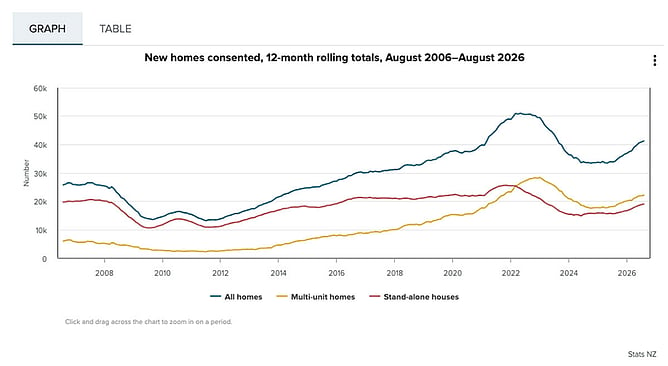
The quarterly picture is also strong. There were 10,964 new homes consented in the June 2026 quarter, up 34 per cent from the same quarter in 2025.
Construction employment is growing but slowly. Stats NZ recorded construction jobs were up 0.9 per cent, or 1,810 jobs, in the year to July 2026. That's a modest number, but it is still good if we look at previous numbers. In the December 2025 quarter compared with the December 2024 quarter, filled jobs in the construction industry were down 3.6%.
Residential
Housing is leading the construction sector recovery, and this is good news. Standalone house consents rose 17 per cent in the year to June 2026, while multi-unit consents rose 21 per cent.
MBIE's National Construction Pipeline Report 2025 forecasts around 215,000 new dwellings consented between 2025 and 2030, roughly 115,000 of them multi-unit, with average annual consents near 36,000.
The growth is regionally concentrated. Westpac's analysis of the June data found Auckland consents up 20 per cent over the year and Canterbury up 33 per cent. Otago too reached a record high for annual new home consents in the year ended June 2026.
Commercial and industrial
Commercial builds have regressed somewhat. Non-residential building consents totalled $8.8 billion in the year ended June 2026, down 2.9 per cent on the previous year. The highest valued non-residential building types were public transport buildings, offices, education buildings, and storage buildings.
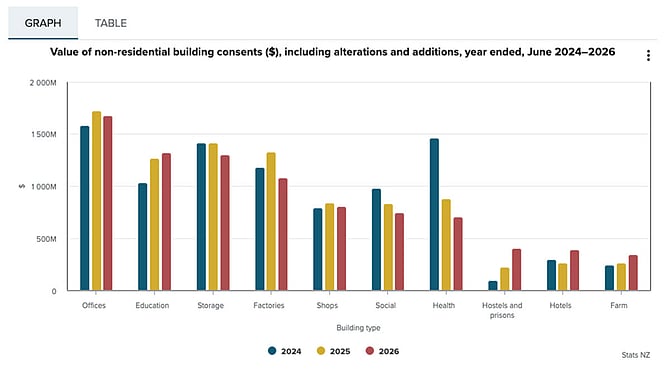
According to economists, businesses are not committing capital to new spaces because they are unsure of what demand looks like in the future.
Civil and infrastructure
MBIE forecasts infrastructure activity to increase year on year, reaching $19.6 billion in 2030, supported by a strong pipeline of projects across the forecast period. Infrastructure projects worth more than $200 billion are underway or being planned as part of the National Infrastructure Pipeline.
Across all three streams, MBIE expects total construction activity to climb from $55.7 billion in 2025 to $65.4 billion by 2030.
Regional picture
Northland. Soft construction employment market overall. Civil and infrastructure provide the main positive.
Auckland. The largest construction market by a distance, with apartment and residential recovery alongside major civil and commercial projects. It also absorbed the deepest job losses in the downturn, so recovery here moves the national numbers most.
Waikato and Bay of Plenty. Among the stronger growth regions, with substantial residential and civil activity.
Central North Island. Weighted toward resource, industrial, forestry and roading work rather than apartments or commercial.
Wellington. Residential construction is comparatively soft. Government, institutional, seismic and infrastructure work carries more of the load.
Nelson and Tasman. A smaller market, with residential and civil construction making up most activity.
Canterbury. One of the strongest markets nationally across residential, commercial and infrastructure.
Otago and Southland. Otago is strengthening, with tourism, infrastructure, industrial and commercial work providing support.
Key takeaway
Construction employment has moved into a recovery phase, though not at the same pace. Residential and infrastructure construction are leading this, but commercial builds are observing a lag.
For construction firms, positioning for the next two years means knowing which of those three streams your business actually sits in, and what it will take to tender for the jobs now coming to market.
If you're gearing up for more work in 2027, Bonded NZ specialises in insurance, warranties and surety bonds for the construction sector. We’ll tailor the right cover for your project and offer a competitive price
Contact our team today to learn more.
Free Marketing for Your Business?
Bonded NZ would like to promote our clients' businesses with no obligation. If you have a special deal, promotion, new service, or offering, we can market your business across our social media channels and our newsletters.
Please reach out to your Bonded NZ contact person for details, or learn more about it here.