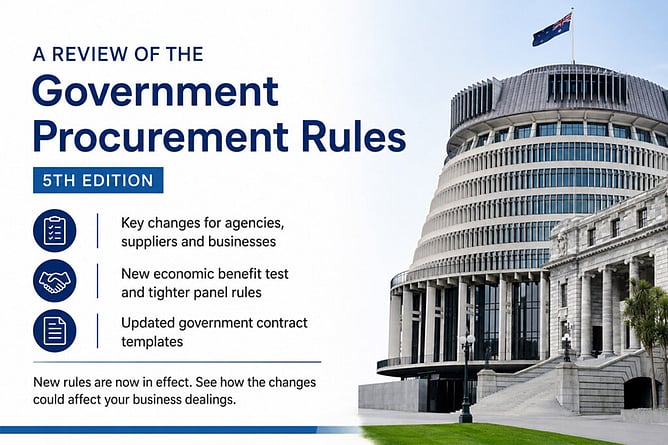
The 5th edition of the Government Procurement Rules has been published following public consultation and has come into effect since December 2025.
For agencies, suppliers, and businesses that work with the public sector, the changes could affect your business dealings. Here’s a quick review.
What are the Rules?
The Government Procurement Rules are defined as “the Government’s minimum expectations for public servants when spending public money” under the MIBE website. These rules cover the procurement lifecycle and highlight processes for planning, approaching the market, and managing the contract.
Here are some of the key changes to the 5th Edition.
The New Economic Benefit Test
The most significant change is the introduction of a mandatory “economic benefit test.” It replaces the previous "broader outcomes" concept, which focused on secondary benefits that are generated from the procurement activity (environmental, social, economic or cultural).
The "economic benefit test" will focus on the broader economic benefits for New Zealand. Agencies must apply a minimum 10% weighting for economic benefits as part of the evaluation criteria for proposals.
Examples of economic benefits include:
Employing workers
Using New Zealand businesses as subcontractors or otherwise in the supply chain
Developing New Zealand industry capability or capacity
Developing and creating export opportunities for New Zealand goods and services
Agencies must also monitor suppliers throughout the life of the contract. This means keeping good practice in delivery and reporting.
Tighter Rules for Supplier Panels and Secondary Procurement
One of the more practical changes in the 5th edition concerns how supplier panels are set up and managed. Agencies now need to have a contract management plan and guide in place before establishing a panel, setting clearer expectations for how the arrangement will happen.
Transparency is also tightened for secondary procurements above $100,000. Agencies must either publish a contract award notice, or report panel spend to NZGP on an annual basis. This report should cover estimated and actual spend, plus the number and value of contracts awarded to each supplier on the panel.
A Refresh to Government Contract Templates
In addition to the new rules, NZGP published updated versions of its standard Government Model Contract (GMC) templates in August 2025. These changes are minor, but include:
Clearer guidance on how agency and supplier obligations overlap under the Health and Safety at Work Act 2015
New references to security and protective security requirements
A new clause to reference the Supplier Code of Conduct.
A new clause on Employment Standards to support the government’s policy objectives to achieve good employment standards.
Updated copies are available on the New Zealand Government Procurement website.
What Does This Mean for Businesses?
According to Denton, the new rules are a positive step. They give SMEs clearer pathways to win government contracts, while still allowing agencies to work with international partners where that delivers the best outcome for New Zealand. On a practical level, cutting the number of rules from 71 to 47 is welcome, but Denton notes that it’s unsure whether it will translate to a simpler experience on the ground remains to be seen.
For any new procurement, though, agencies are expected to be working to the new framework. The message from MBIE is clear: government spending should be doing more than simply buying goods and services; it should be actively working to benefit New Zealand.
If you’re looking for comprehensive, tailored business insurance to protect yourself and your business, Bonded NZ offer a range of products at different price points suitable for your needs.
For more information about our types of cover, contact our team today.
Promote Your Business With Bonded NZ!
Bonded NZ would like to promote our client’s business without obligations! If you have a special deal, promotion, new service, or offering, we can spread the word on our social media channels and our newsletters.
Please reach out to your Bonded NZ contact personnel for details, or learn more about it here.