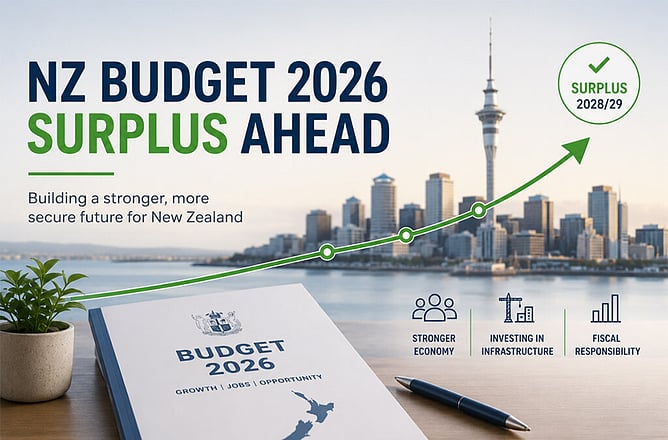
The government is betting on spending discipline, falling fuel prices, and a resolution to the Middle East conflict to uplift the country's books sooner than expected. The Budget now forecasts a surplus in 2028/29, making it a full year earlier since the December update.
"New Zealand is digging its way out of the post-Covid hole," says Finance Minister Nicola Willis.
"What sets this government apart is that it is doing so within a funding envelope that is affordable and responsible, while continuing the fiscal repair needed to put New Zealand on a stronger footing."
When Surplus Becomes Possible
It’s important to note that the Treasury's forecasts are based on the assumption that the impact of the Middle East conflict on global fuel prices will be temporary. Currently, the Middle East conflict is expected to slow growth and push inflation up in the short term, leaving the operating deficit (OBEGAL) at $11.4 billion for 2026/27.
But if fuel prices ease, Treasury expects that to create stronger business investment and stimulate household spending, which would lift tax revenue. Combined with the government’s tight spending controls, the deficit is projected to more than halve in 2027/28, before going into a $2.6 billion surplus the following year.
“While global uncertainty remains, even the Treasury's downside scenario shows OBEGAL returning to surplus in 2028/29," Willis said.
What is the Government Spending and Cutting
The Government has trimmed its day-to-day operational allowance (which covers public services) to $2.1 billion this year. The allowance will be capped at $2.4 billion in the years ahead.
On the investment side, $5.7 billion has been set aside for capital projects, including hospital upgrades, schools, KiwiRail, roads, and defence equipment. Willis described that more than 220,000 jobs are expected to be created over the four-year forecast period because of these projects.
The Crown's debt holding in telecommunications company Chorus is also being sold, freeing up hundreds of millions for other priorities. Banks will be levied to cover the costs of their regulatory supervision.
Of Borrowing Capacities
An interesting element of this budget is the government's borrowing. Financial markets had been expecting an increase of up to $10 billion in borrowing over the next four years. Instead, the budget projects a $6 billion reduction between 2028 and 2030.
Net debt is forecast to peak at 46.1 per cent of GDP in 2028 before beginning to fall.
“It shows what is possible when you show discipline," Willis says.
What the Economy Looks Like From Here
Treasury has pulled back its near-term growth forecasts due to global uncertainty. Growth will be slower for the rest of 2026, then forecasted to pick up to an average of 2.7 per cent annually over the following three years.
Unemployment is expected to reach 5.5 per cent this year before gradually declining to 4.4 per cent. Meanwhile, wage growth is forecast at around 2 per cent.
Lastly, inflation is projected to hit 4 per cent this year as fuel costs rise, then drop sharply to 1.6 per cent in 2027/28 as those pressures ease, before settling back around the Reserve Bank's 2 per cent target.
What It Means for Kiwi Businesses
While the Budget outlook is showing steadier ground for many businesses, it is still reliant on global events. Questions remain whether the political conflicts and fuel prices will ease in the foreseeable future.
If you’re a business planning to secure yourself in an uncertain market, Bonded NZ offers a range of products at different price points suitable for your needs.
For more information about our types of cover, contact our team today.