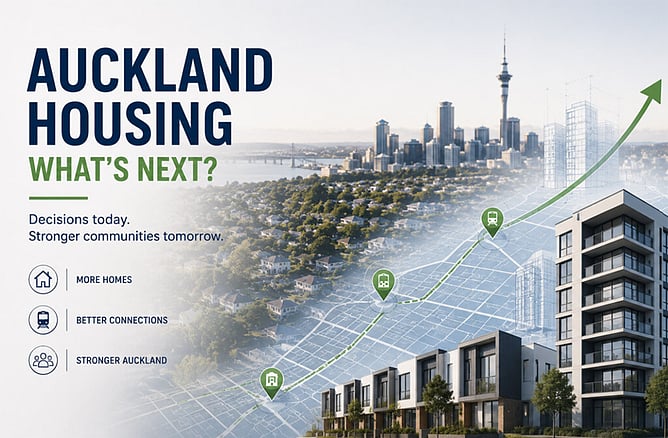
Auckland Council is deciding how much of its housing intensification plan to keep. Councillors were presented with six options, ranging from doing the bare legal minimum to preserving the original rezoning of Plan Change 120.
The trigger for all of this was a Government decision to slash the minimum number of homes Auckland must plan for, from 1.6 million to 1.4 million. This led to a cascade of decisions about how far to wind back Plan Change 120, the rezoning plan originally designed to provide the city with development opportunities.
What the Four Options Actually Mean
Council staff laid out four main scenarios. At the conservative end, Scenario A (called ‘essentials only’) would limit the plan change to only the mandatories: six-storey buildings in most walkable areas near town centres, train and busway stations, with a handful of Western Line stations pushing ten to fifteen storeys.
There’s also a Scenario A variant called A1, which would go further, formally withdrawing the wider suburban area from the plan change entirely. That suburban zone covers roughly 75 to 80 per cent of Auckland's urban land.
Scenario B sits in the middle, keeping intensification around town and local centres but dialling back height limits in outer areas and reverting bus corridors to current settings.
Scenario C is more ambitious, tying rezoning to public transport access across the city and retaining townhouse-style upzoning along most inner-city bus routes. Scenario D is essentially the original Plan Change 120, keeping capacity for around two million homes.
A Big Decision
Auckland Mayor Wayne Brown made clear he wasn't comfortable making big calls based on high-level maps.
"People will be pissed off if we wreck their houses," he said, calling for local boards to be given street-level maps and a proper say.
"There's just no detail here. You look at that, and holy shit, I could vote on this. I could be making some humongous errors to people's lives here."
Brown pushed for local input to reflect the reality on the ground.
Franklin councillor Andy Baker echoed those concerns. He pointed to Pukekohe's main street, where height restrictions had long protected sunlight into the street.
"Successive councils have protected the sunlight into that by restricting the height on the northern side of the street, so that because that is a big thing for the street, that is what makes Pukekohe's township such a buzzing, bloody great place," he said.
"Under Plan Change 120, half of the street goes six storeys on both sides, that will kill the street, that will kill Pukekohe as a town, and because it will become a dark, dirty wind tunnel that no one will want to go to."
Councillors Split on Decision
At the workshop, councillors were presented with modelling for each scenario. More housing capacity can lower house prices by 1% to 2% under the most stripped-back option, and by 5% to 8% under the full plan change.
It’s estimated that the 10-year economic benefit ranged from $700 million with Scenario A to $3.9 billion under the scenario closest to the original plan.
Councillor Newman supported Scenario A. Meanwhile, Waitākere councillor Shane Henderson said the economic evidence supported doing more. He said he preferred the original plan change, "but that's just not going to get support."
"I think we do have a reason to placemake and to try and help people's household bills around housing and all those kinds of things. We do have an interest in house prices as a council and try and help people. Scenario C does that the best."
Albert-Eden-Puketāpapa councillor Julie Fairey also preferred Scenario C and raised concerns about removing people's rights.
"I'm quite keen on C — I'm really worried about withdrawing and potentially removing people's rights and expectations, even if we are going for one of the smaller scenarios."
A final decision on amendments is expected in late July. The plan will also go through another round of feedback by Auckland residents later this year.
Looking for Security in a Volatile Market?
Bonded NZ helps builders and contractors find the best insurance, warranties, and surety bonds that keep their best interests in mind. Whether it's a big or small project, our cost-effective options help them secure their projects at every angle.
For more information about our services, contact our team today.