Ever wondered how old New Zealand’s infrastructure is?
A recent study shows that most of the infrastructure we see today was built in the 40 years after World War 2.
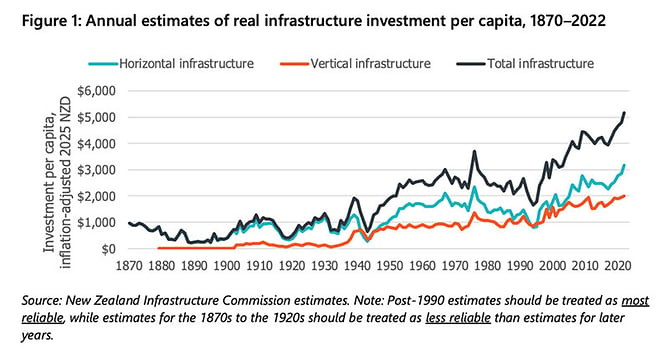
According to the Infrastructure Commission, the average Kiwi spent about $3,000 per year on infrastructure development 50 years ago, but that figure is now around $5000.
The study also shows that infrastructure investment over the last two decades has consistently been close to the long-run average at 5.8% of the nation’s GDP. Today, New Zealand is spending more than ever on infrastructure.
Prioritising Investments
The study, which was publicly released on the Commission’s website, provides a clear understanding of our nation’s infrastructure networks. It collates 150 years of data to help prioritise where to spend money on maintenance and replacements.
Peter Nunn, the Infrastructure Commission’s general manager, says there were no cases in which the country spent less than 5% or more than 7% of GDP on infrastructure. He notes that there were four periods when infrastructure investment per GDP exceeded the norm. They include:
· The Vogel boom from 1870 to 1887 that involved building roads and rails
· The pre-war boom from 1904 to 1914, following the recovery from the Long Depression
· The inter-war boom from 1927 to 1940, following the recovery from the First World War
· The post-war boom from 1949 to 1979 following population and economic growth after the Second World War.
Maintaining Our Infrastructure
According to Nunn, the majority of New Zealand’s infrastructure was built by about the 1970s, with "very little" since then.
"We moved at that point, where we had the infrastructure, into continuing to maintain it, obviously we didn't always do that, so now we're in a catch-up phase."
The "big boom" for infrastructure hit from the 1920s to 1970s, Nunn said when the road network was paved and motorway networks were created.
"We're continuing to infill, expand the networks, pace with the population... we've gone through the work phase.
"We go through that cycle [where] we add capacity to the sites [like hospitals and schools], that we've already got, rather than adding more sites."
As the population grows, electricity and healthcare infrastructure must be looked at. For public hospitals, Nun says the number of hospital beds peaked in 1945 and then declined in the 90s and 2000s.
"We haven't been growing the size of the hospital network since the 70s or 80s.. now the phase we're entering into at the moment, highlights the population is going to shift quite dramatically... we're going to get a lot older and the need for hospitals is going to rise."
With electricity, Nunn states that the nation will also need to generate more power.
"Which means more wind farms, more solar farms, more battery storage, and in terms of distribution it depends on where things are located and whether new links need to be built or existing links updated."
Key Takeaway
With significant population growth, building companies and their stakeholders could possibly face an uptick in construction activity.
Staying ahead is prudent, as is securing one’s construction projects. With a forecast of more infrastructure spending in the future, builders who are protected can take on more jobs securely.
Bonded NZ helps builders and homeowners find the best insurance, warranties, and surety bonds that keep their best interests in mind. Whether it's a big or small project, our cost-effective options help them secure their projects at every angle.
For more information about our services, contact our team today.
See the full study by The New Zealand Infrastructure Commission here.