New Zealand’s building and construction sector will shift from the current ‘joint and several’ model to ‘proportionate liability’ in a new move by the government.
According to a statement by Building and Construction Minister Chris Penk, this measure tackles risk-averse behaviour that slows productivity and delivery of new homes.
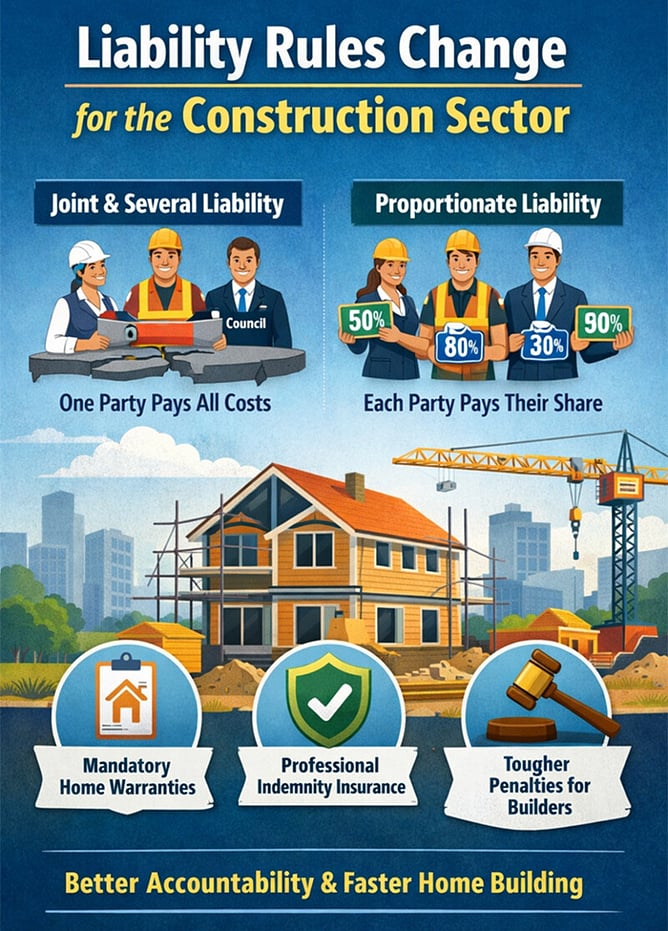
Under joint and several liability, one party (often local councils) typically ends up paying for others who can’t meet their obligations in construction work. Proportionate liability states that each party involved in a defective building is responsible for the costs of their own share of the fault.
Better Accountability and Fairness in the Sector
According to Minister Penk, local councils have the highest cost when there is an issue with a building project. This slows productivity and adds further delays to the building of new homes.
“Right now, councils can be hesitant to sign off on the building projects New Zealand needs because they risk being held fully liable for defects they did not cause, to the tune of millions of dollars,” Penk said.
“This occurs because under the current law, when two or more parties are involved in a mistake, the customer can pursue any one of them for the full damages, regardless of each party’s level of contribution,
“Councils have the deepest pockets and cannot walk away by filing for insolvency, meaning that ratepayers often end up paying for mistakes made by others, even when the local council’s involvement was limited to signing off the work.”
Penk states that moving to a proportionate liability model will speed up consenting and ease the burden on ratepayers.
Supporting Measures
The government acknowledges that support measures must be put in place for this shift to proportionate liability. They include:
Mandatory home warranties for all new residential buildings 3 storeys and under, and renovations $100,000 and above, covering a 1-year defect period and a 10-year structural warranty.
Requiring professionals contributing to building design, such as architects and engineers, to hold professional indemnity insurance. These requirements do not apply to builders.
Strengthening disciplinary penalties for Licensed Building Practitioners (LBPs) by increasing the maximum fine from $10,000 to $20,000 and the maximum suspension period from 12 months to 24 months.
Penk adds that home warranty schemes are widely available across New Zealand and assures homeowners that they can find many options best suited to their project. He also adds that strengthening the LBPs will prevent “cowboys” and those who cut corners from unfairly damaging the industry’s reputation.
“Together, these measures provide strong protections that underpin building system reforms, safeguard building owners, boost consent productivity, enforce accountability, and make building faster, easier and more affordable,” he said.
Key Takeaway
The Home warranty and professional indemnity insurance changes are expected to progress alongside other reforms through the Building Amendment Bill, and the LBPs will be via a separate bill in 2026. The government will introduce a 1-year implementation period for the change to proportionate liability.
Now more than ever, builders and homeowners must secure their projects with the right insurance that covers them in the event of a fault. Having the right broker with multiple insurance and home warranty options can protect you from risk while ensuring you don’t overpay for coverage you don’t need.
Bonded NZ helps builders and homeowners find the best insurance, warranties, and surety bonds that keep their best interests in mind. Whether it's a big or small project, our cost-effective options help them secure their projects at every angle.
For more information about our services, contact our team today.