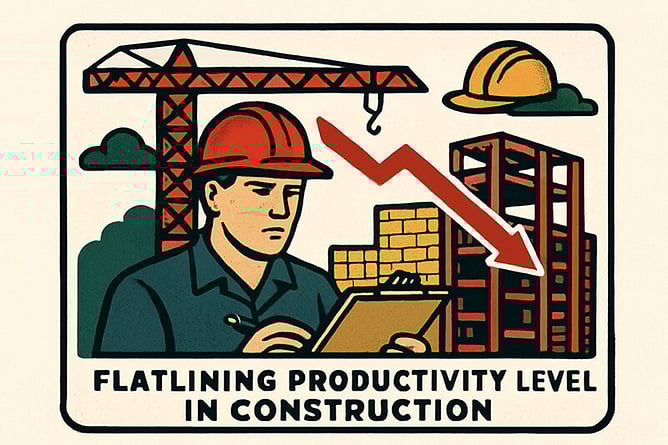
According to Mike Kirby, a Construction Industry Consultant at Auckland University of Technology, the “buy now, fix later” building culture is costing the New Zealand economy around $2.5 billion.
In an article in The Conversation, he writes that productivity levels in the industry have flatlined since the mid-1980s. This is critical in a sector that contributes roughly $26 billion annually to the local economy and employs around 70,000 workers.
Productivity is important. It reflects the industry’s ability to produce high-quality homes without delays or defects, not just output. However, the sector has seen builders spend more time rectifying avoidable mistakes than building homes.
92% of new homes in New Zealand had compliance defects and have a high annual cost of defective buildings to the overall economy.
“The results show that economy-wide effects of an increase in productivity would see New Zealand’s GDP rise by $2.5 billion, as the industry’s overall costs of production decrease.”
To put it in perspective, the industry loses 10% of its total value due to systemic failure. It’s equivalent to 5,000 missing homes each year, according to calculations based on the average construction cost of an Auckland home.
Although the government has introduced major reforms to the construction industry, Kirby mentions in the article that “better quality management is key to remedying the industry’s ‘build now, fix later’ culture.”
Prioritising Quality Over Time and Costs
Kirby’s research has surveyed 106 residential construction professionals, including general managers, construction managers, site managers, project managers and subcontractors.
In a question about government policy and residential construction productivity, he found that a culture prioritising time and cost over quality is a “systemic norm at the industry level.”
From the mid-1980s, New Zealand's building industry underwent a fundamental shift, guided by standards set by the Ministry of Works. This posed a problem.
“But by 1988, those standards were viewed as a barrier to efficient market operation, effectively ending the era of the state as master builder.”
The New Zealand Building Code has replaced these standards, focusing on a performance-based model. But without the strict procedural guidance, there was insufficient emphasis on quality management, favouring speed and efficiency.
Ticking the Boxes
According to Kirby, New Zealand’s residential construction sector faced not only poor-quality control but also a general lack of a quality-focused culture.
“The 1980s shift to a hands-off, self-regulated model helped foster a ‘tick-box’ culture rather than genuine organisational reform. This has meant that with every step forward, the industry is pulled back by the need to fix previous errors, stalling productivity.
On the building site, this manifested as a disconnect between the “work as imagined” (the manuals and checklists from head office) and the “work as done” by builders and subcontractors.”
The outcome is felt even today, with New Zealand still managing the leaky home crisis. Additionally, poor-quality, damp, and mouldy housing has led to respiratory illnesses, which cost the country $145 million in annual hospitalisations.
“In Auckland alone, one-third of all projects fail their final inspection. The high volume of remedial work required chokes the entire system’s throughput.”
Proposed Intervention
The article proposes a framework for the industry underpinned by lean principles. Using the ISO 9000 standards that New Zealand already has in place for exports, Kirby argues that the government should:
Create a nonpartisan national construction, productivity and quality commission. It should be staffed by industry and academic experts to ensure reforms last beyond three-year election cycles.
Mandate quality management systems that meet ISO 9000 standards for all government-funded residential projects.
“Fixing an annual $2.5 billion problem requires a structural shift. Our research proposes a framework where the state, as the primary funder and driver of major construction, sets the standard the rest of the industry must adopt.”
Protecting Construction Projects
Rising defects that delay construction projects are often beyond homeowners’ control. However, it can significantly affect many individuals, both financially and emotionally. These scenarios can be reduced altogether by implementing additional protections against contractor defaults.
Project Protect NZ is an insurance policy that provides a job completion guarantee for residential homes. If a contractor is unable to complete the job, Project Protect ensures the deposit is protected, and a replacement builder is engaged to complete the work.
Our team at Bonded NZ will manage the entire claims process to provide you with a stress-free experience.
To learn more about Project Protect NZ, visit our website or contact our friendly team for any questions and queries. We’d be happy to help.